


Nearly all HPV content online is written for women. That is a problem, because HPV in men is just as common — and the lack of reliable information leaves most men either uninformed or unnecessarily alarmed. There is no routine HPV test for men, most infected men have no symptoms at all, and the majority clear the virus without ever knowing they had it. This article is written for you, not adapted from a women's health guide.
Key Takeaways
- More than half of sexually active men in the United States will have HPV at some point in their lives, yet most will never know it.
- There is no approved routine HPV test for men — detection typically happens through visible symptoms or partner notification.
- Most men clear HPV naturally through their immune system within one to two years, without any treatment.
- A small number of men face real but rare risks — primarily genital warts and, less commonly, HPV-related cancers.
- The most effective tools available to men are vaccination (if eligible), immune support, and regular medical checkups for high-risk individuals.
In This Article
- How common is HPV in men?
- Symptoms — why most men have none
- Why there is no HPV test for men
- What HPV can cause in men
- Men at higher risk
- Your partner has HPV — what does that mean for you?
- Genital warts in men
- Does the HPV vaccine help men?
- Supporting natural clearance
- When to see a doctor
- Frequently asked questions
Most men with HPV never know they have it — no symptoms, no standard test, and usually no long-term consequences.
How Common Is HPV in Men?
HPV is the most common sexually transmitted infection in the United States — and men are not exempt. According to the CDC, more than half of all sexually active men will have HPV at some point in their lives. At any given time, approximately one in three men carries an active HPV infection. Around 21% of men carry a high-risk strain — the type associated with cancer rather than warts.
Those numbers sound significant, and they are. But context matters. The overwhelming majority of men with HPV never develop symptoms, never receive a diagnosis, and never experience any health complication from the virus. The immune system handles most HPV infections quietly and completely, typically within one to two years of exposure.
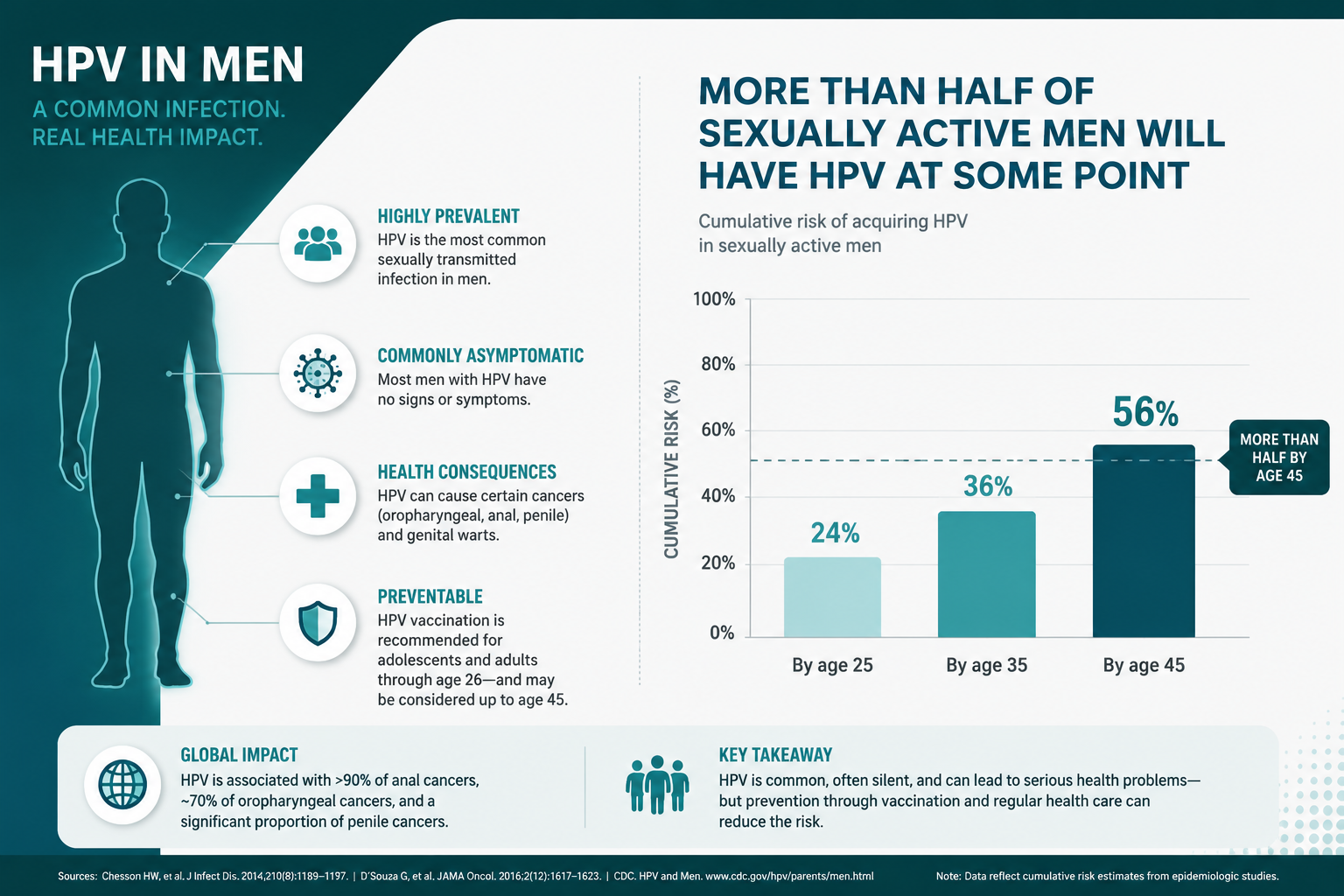
More than half of sexually active men will encounter HPV — most will clear it without ever knowing.
HPV is not a single virus. There are more than 200 strains, roughly 40 of which affect the genital area. These strains are divided into two broad categories:
| Category | HPV Strains | What They Cause |
|---|---|---|
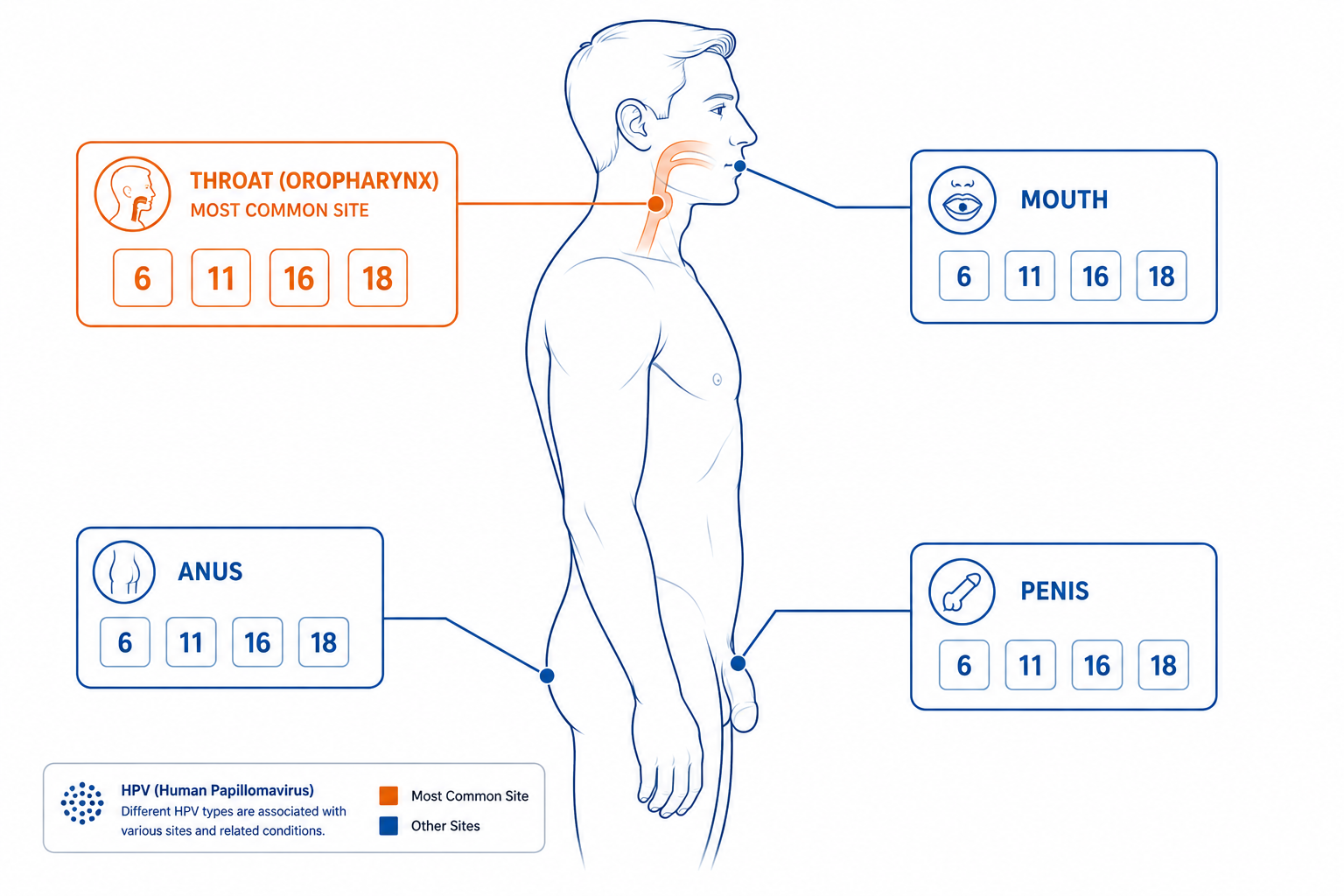
| Low-risk | 6, 11 | Genital warts (rarely, laryngeal papillomatosis) |
| High-risk | 16, 18, 31, 33, 45, others | Potential precancerous cell changes; cancer in rare cases |
Understanding which category applies to your situation — if you have any information at all — shapes everything else.
Symptoms — Why Most Men Have None
The central reality of HPV in men is this: most men with the virus feel nothing, see nothing, and notice nothing. High-risk HPV strains — the ones associated with cancer — almost never produce visible symptoms in men. The virus infects cells at the surface of the skin or mucous membranes, replicates quietly, and in most cases is cleared by the immune system before any visible change occurs.
Low-risk strains, particularly types 6 and 11, can cause genital warts — small, flesh-colored growths on or around the penis, scrotum, thighs, or anus. These are visible and sometimes uncomfortable, but they are not cancer and do not become cancer.
What the absence of symptoms does not mean:
- It does not mean you do not have HPV
- It does not mean you cannot transmit HPV to a partner
- It does not mean the infection will persist — most infections clear on their own
The frustrating reality is that HPV in men is largely invisible until either warts appear or a partner's test comes back positive. That invisibility is not a reason for alarm. It is simply the biology of how this virus behaves in the male body.
Why There Is No HPV Test for Men
This is one of the most common — and most legitimate — frustrations men have when they learn a partner has HPV. You want to know if you have it. There is no approved routine test to tell you.
Unlike women, who have access to cervical HPV testing as part of routine Pap screening, men have no equivalent standard clinical tool. The reasons for this gap are practical and medical:
- HPV in men tends to clear more easily. The male immune response to genital HPV appears to resolve most infections without clinical intervention.
- Male HPV-related cancers are rarer. Cervical cancer, which affects women, is far more common than penile or anal cancer, making population-wide male screening harder to justify on a cost-benefit basis.
- No clear clinical action follows a positive result. If an asymptomatic man tested positive for high-risk HPV, current guidelines offer no established treatment pathway — which reduces the clinical utility of testing.
A 2025 review published on PubMed (PMC12256477) examined the necessity and ongoing challenges of HPV testing in men, acknowledging this gap as a genuine public health issue — one that researchers are actively working to address.
What about anal Pap smears? An anal Pap smear does exist and is recommended for certain high-risk men — specifically men who have sex with men (MSM) and men living with HIV. However, it is important to understand what it tests: it screens for abnormal cell changes in the anal canal, not for HPV directly. It is a cancer-prevention tool, not an HPV detection test.

Unlike women, men have no routine approved HPV screening test — detection typically happens through symptoms or partner notification.
The absence of a test is not a failure of medicine to care about men — it reflects a genuine clinical complexity. Acknowledging that gap honestly is more useful than pretending a test exists or suggesting that the lack of one means nothing.
What HPV Can Cause in Men
Most men with HPV will never develop any complication. That statement is not reassurance — it is an accurate reflection of the data. But it is also true that HPV can cause real health problems in men, and those deserve honest discussion.
| Condition | HPV Strains | Notes |
|---|---|---|
| Genital warts | 6, 11 (low-risk) | Treatable; not cancer, will not become cancer |
| Oropharyngeal cancer | 16 (primarily) | Most common HPV-related cancer in men; incidence rising |
| Anal cancer | 16, 18 | Higher risk in MSM and HIV-positive men |
| Penile cancer | 16, 18 | Rare, even among HPV-positive men |
Oropharyngeal cancer — cancer of the back of the throat, base of the tongue, and tonsils — is now the most common HPV-related cancer in men in the United States, according to the National Cancer Institute. Its incidence has risen steadily over the past two decades, primarily driven by HPV type 16 transmitted through oral sex. For a deeper look at how this infection develops without obvious signs, see Oral HPV: The Silent Infection No One Talks About.
Anal cancer and penile cancer are real but rare, even in men who carry high-risk HPV strains. The risk is meaningfully higher in specific populations — discussed in the next section. For a detailed breakdown of what HPV types 16 and 18 specifically do at the cellular level, that topic is covered separately in the NovaHerbs guide to why HPV 16 and 18 are the most dangerous strains.
The key point: these cancers are not inevitable, not even probable, for most men. A healthy immune system is the primary defense, and most HPV infections never progress to anything more serious.
Men at Higher Risk
While HPV in men is broadly common and broadly benign, certain groups face a meaningfully different risk profile. Understanding where you fall on that spectrum is clinically useful.
| Risk Factor | Why It Matters | Recommended Action |
|---|---|---|
| Men who have sex with men (MSM) | Significantly higher rates of anal HPV; anal cancer risk 17x higher than in heterosexual men | Discuss anal Pap screening with a provider |
| Men living with HIV | Impaired immune clearance; substantially higher cancer risk across all HPV-related sites | Regular monitoring; discuss with HIV care provider |
| Men who smoke | Smoking suppresses local immune surveillance in mucosal tissue | Smoking cessation is the single most impactful lifestyle change |
| Men over 45, unvaccinated | Longer cumulative exposure; declining immune response with age | Consider vaccination if eligible; discuss with provider |
| Men with multiple sexual partners | Greater exposure probability | Vaccination, consistent condom use |
Smoking deserves particular emphasis. It is one of the most modifiable risk factors for HPV persistence and progression, and its immune-suppressing effects on mucosal tissue are well-documented. If you smoke and have HPV, cessation is not optional advice — it is the most direct action you can take.
There is also emerging evidence that HPV may affect sperm quality and male fertility in some cases. If fertility is a concern, the article Can HPV Affect Fertility? covers that topic in detail.
Your Partner Has HPV — What Does That Mean for You?
This is one of the most frequently searched questions related to HPV in men, and it deserves a direct, calm answer.
If your partner has tested positive for HPV, you may already have been exposed. Given that there is no routine test for men, there is currently no way to confirm whether you carry the virus. That uncertainty is uncomfortable, but it does not change the likely outcome: most men in this situation clear the virus naturally without any intervention.
A few things are important to understand clearly:
- HPV does not mean infidelity. The virus can remain dormant in the body for months or years before a test detects it. A positive result today may reflect an exposure from years ago, from either partner. Attributing a diagnosis to recent behavior is often inaccurate and always unfair.
- You cannot be tested. This is not a failure of the healthcare system to take your concern seriously — it is a genuine clinical gap acknowledged by researchers.
- Your partner's diagnosis is not a crisis for your health in most cases. It is information. The appropriate response is to not panic, consider vaccination if you are eligible, support your partner through what can be a stressful experience, and focus on your own immune health.
- Condom use reduces transmission risk but does not eliminate it, since HPV can be present on skin not covered by a condom.
The emotional weight of this situation — the uncertainty, the relationship stress, the unanswered questions — is real. Acknowledging that is part of giving you an honest picture.
Genital Warts in Men
Genital warts are caused by low-risk HPV strains, primarily types 6 and 11. They appear as small, flesh-colored or slightly raised growths on or around the penis, scrotum, inner thighs, or anal area. They can be single or clustered, flat or raised, and are sometimes described as resembling a small cauliflower in texture.
Key facts:
- Genital warts are not cancer and do not become cancer
- They are treatable, but treatment removes the wart — not the underlying virus
- Recurrence is possible after treatment because the virus may still be present in surrounding tissue
- Treatment options include topical prescription creams (imiquimod, podophyllin), cryotherapy (freezing), and minor in-office procedures
Do not attempt to self-diagnose or self-treat. Any unusual growth on or around the genitals should be evaluated by a clinician. Other conditions can mimic genital warts, and a visual or clinical exam is the appropriate way to confirm a diagnosis.
If you have been diagnosed with genital warts, your doctor can discuss treatment options and monitoring. The presence of warts does not indicate anything about your high-risk HPV status — they are caused by entirely different strains.
Does the HPV Vaccine Help Men?
Yes — and it is underused in men. Gardasil 9, the HPV vaccine currently available in the United States, is approved for males and provides meaningful protection.
What Gardasil 9 covers:
- HPV types 6 and 11 — the primary causes of genital warts
- HPV types 16 and 18 — responsible for the majority of HPV-related cancers
- Five additional high-risk strains: 31, 33, 45, 52, 58
Who should consider it:
- All males through age 26 — routine recommendation
- Males ages 27–45 — available as a shared clinical decision with a healthcare provider
- MSM of any age within the approved range — particularly recommended given higher anal cancer risk
What it does not do: The vaccine prevents new infection with the strains it covers. It does not treat an existing HPV infection. However, even men who have had some HPV exposure may benefit from vaccination, as it protects against strains they have not yet encountered.
The vaccine is most effective before any sexual activity begins, but it retains value for sexually active men who have not been vaccinated. If you are unsure whether you have received it, check with your healthcare provider.
Gardasil 9 protects men against HPV strains linked to genital warts and several cancers — it is recommended through age 26 routinely.
Supporting Natural Clearance
The immune system is the only mechanism that clears HPV. There is no antiviral medication that directly targets the virus. That means everything that supports immune function also supports your body's ability to resolve an HPV infection.
Evidence-based lifestyle factors:
- Smoking cessation — the single most impactful change for men with HPV; smoking directly impairs mucosal immune surveillance
- Vitamin D optimization — NIH research links adequate vitamin D levels to stronger immune response; deficiency is common and correctable
- Sleep — seven to nine hours per night supports T-cell activity and overall immune regulation
- Stress reduction — chronic stress elevates cortisol, which suppresses immune function over time
- Nutrition — a diet rich in vegetables, lean protein, and antioxidants supports immune cell production
Some men also ask about why HPV persists in certain individuals despite these measures. That question is addressed in detail in the NovaHerbs article on why HPV does not clear in some people.
On AHCC: Among supplements studied in relation to HPV, AHCC (Active Hexose Correlated Compound) is the only one with a published, placebo-controlled human clinical trial targeting HPV clearance. The research was conducted by Dr. Judith Smith at the University of Texas Health Science Center at Houston, using 3 grams per day taken fasted for a minimum of six months. The results were promising. It is important to note that the published trial focused on women with cervical HPV — the immune mechanisms involved are the same in men, but direct clinical evidence specifically in men is more limited. AHCC should be framed as a promising immune-support option, not a proven HPV treatment.
NovaHerbs AHCC provides 700 mg per capsule, manufactured in the USA in a GMP-certified facility. At the research-validated dose of 3 grams per day on an empty stomach, that equates to approximately four to five capsules daily. For a thorough review of the clinical evidence, see Does AHCC Really Help Clear HPV? For dosing specifics, the dedicated guide on what dosage of AHCC to take for HPV covers that topic in full.
NovaHerbs AHCC provides 700 mg per capsule, made in the USA in a GMP-certified facility.
When to See a Doctor
Most men with HPV do not need urgent medical attention. But certain symptoms warrant prompt evaluation — not because they are automatically serious, but because they deserve proper assessment.
See a clinician if you notice:
- Any unusual growths, warts, or lesions on or around the genitals, scrotum, or anus
- Persistent sore throat or hoarseness lasting more than two weeks
- A lump in the neck that does not resolve
- Anal bleeding, pain, or unexplained changes in bowel habits
- Any skin change on the penis that does not heal
If you are MSM or HIV-positive: Discuss anal Pap screening with your healthcare provider. This is a proactive step that can detect cell changes before they progress.
None of these symptoms automatically indicate HPV or cancer. They indicate that a trained clinician should take a look. Early evaluation is always preferable to waiting.
Frequently Asked Questions
Can men get HPV from oral sex?
Yes. HPV can be transmitted through oral sex, and this is the primary route by which oropharyngeal HPV infections occur in men. HPV type 16 is responsible for the majority of HPV-related throat cancers, and its transmission through oral-genital contact is well-established. Most oral HPV infections clear on their own, but persistent infection with high-risk strains can, over many years, contribute to oropharyngeal cancer. Regular dental and throat checkups can help identify any concerning changes early.
Can a man spread HPV without knowing he has it?
Yes. Because most men with HPV have no symptoms and no available test, transmission can occur without either partner being aware. HPV is transmitted through skin-to-skin contact in the genital area — not just through penetrative sex. A man can carry and transmit the virus while feeling completely healthy. This is one reason why HPV is so widespread: it circulates silently through populations without visible markers.
Do condoms protect against HPV in men?
Condoms reduce the risk of HPV transmission but do not eliminate it. Because HPV spreads through skin-to-skin contact rather than only through bodily fluids, areas not covered by a condom — the base of the penis, scrotum, inner thighs, and perianal skin — can still transmit the virus. Studies show that consistent condom use is associated with lower HPV transmission rates and faster clearance in female partners, but condoms should be understood as a risk-reduction tool, not a complete barrier.
Should men get the HPV vaccine if they are already sexually active?
In most cases, yes — if they are within the approved age range and have not been fully vaccinated. The vaccine protects against strains not yet encountered, and most sexually active men have not been exposed to all nine strains covered by Gardasil 9. The vaccine is less effective against strains already present, but it still provides meaningful protection against future exposure. The decision should be made with a healthcare provider, particularly for men over 26.
What should a man do if his partner tests positive for HPV?
Stay calm, get informed, and avoid assigning blame. A partner's positive HPV result does not indicate recent infidelity — the virus can remain dormant for years. There is no test available to confirm whether you carry the virus, so the focus should shift to what you can control: consider vaccination if eligible, support your immune health, use condoms consistently, and support your partner through what can be a stressful experience. If you have any symptoms — warts, unusual lesions, or persistent throat changes — see a clinician.
Conclusion
HPV in men is common, often invisible, and in most cases self-resolving. The absence of a routine test is frustrating but does not leave you without options. The most important actions a man can take are also the most straightforward.
Next steps:
- Get vaccinated if you are eligible. Gardasil 9 is available through age 26 routinely and through age 45 by clinical decision. If you have not received it, ask your provider.
- Support your immune system actively. Quit smoking, optimize vitamin D, prioritize sleep, and manage chronic stress — these are not vague wellness suggestions; they are the direct inputs that determine whether your immune system clears HPV efficiently.
- See a doctor if you notice symptoms. Any unusual growth, persistent sore throat, or unexplained lump deserves evaluation. Do not wait.
- If you are MSM or HIV-positive, discuss anal Pap screening. This is a concrete preventive measure available to you.
- If your partner has HPV, respond with information rather than panic. Understand the biology, consider your vaccination status, and focus on what you can control.
HPV in men is a manageable health topic — not a crisis. The men who navigate it best are the ones who get accurate information early and act on it calmly.
Related Reading
- Oral HPV: The Silent Infection No One Talks About — how HPV spreads to the throat and what the risks actually look like
- Does AHCC Really Help Clear HPV? — a full review of the clinical evidence behind the most-studied HPV supplement
- Can HPV Affect Fertility? — what the research says about HPV and sperm quality
- 15 Essential HPV Facts Everyone Should Know — a concise, evidence-based overview of the most important HPV information
References
- Centers for Disease Control and Prevention. HPV and men — fact sheet. https://www.cdc.gov/hpv
- National Cancer Institute. HPV and cancer. https://www.cancer.gov/about-cancer/causes-prevention/risk/infectious-agents/hpv-and-cancer
- Harder T, et al. The necessity and challenges of HPV testing for men. PubMed Central, 2025. https://www.ncbi.nlm.nih.gov/pmc/articles/PMC12256477/
- National Institutes of Health, Office of Dietary Supplements. Vitamin D and immune function. https://ods.od.nih.gov/factsheets/VitaminD-HealthProfessional/
- Smith JA, et al. AHCC supplementation to support immune function for clearance of persistent human papillomavirus infections. PubMed. https://pubmed.ncbi.nlm.nih.gov/
These statements have not been evaluated by the Food and Drug Administration. This product is not intended to diagnose, treat, cure, or prevent any disease. Consult your healthcare provider before beginning any new supplement regimen.
By Dr. Zafer Atli | Integrative Medicine & Women's Health


