


Roughly 42 million Americans are currently living with HPV — and for most of them, the virus will quietly disappear without ever causing serious harm. If you just received a positive HPV result and your mind immediately went to cancer, that fear is completely understandable. But the most important thing to know right now is this: for the vast majority of people, HPV does not turn into cancer. The question of whether HPV can turn into cancer has a nuanced answer, and understanding the actual probability at each step of the pathway will replace fear with something far more useful — accurate information.
Key Takeaways
- Approximately 90% of HPV infections clear naturally within two years without causing any lasting harm.
- Only about 10% of infections become persistent, and persistent high-risk infection is the necessary precondition for HPV-related cancer.
- The pathway from initial HPV infection to invasive cancer typically takes 10 to 20 years — a window that screening is specifically designed to interrupt.
- Not all HPV types carry cancer risk. Only approximately 14 high-risk strains are linked to cancer, with HPV 16 and 18 responsible for roughly 70% of cervical cancers worldwide.
- Regular screening, smoking cessation, and immune support are the most evidence-based actions available to reduce progression risk.
In This Article
The Short Answer
Yes, HPV can turn into cancer — but for most people who test positive, it does not. According to the CDC, approximately 90% of HPV infections clear on their own within two years, driven by a functioning immune system that recognizes and suppresses the virus. The remaining 10% of infections become persistent, and it is within that persistent group — specifically those carrying a high-risk strain — where cancer risk begins to accumulate.
Even within that persistent, high-risk group, cancer is not inevitable. It requires a specific, slow-moving sequence of events: the infection must persist for years, cellular changes must develop and go undetected, and those changes must progress through multiple stages without intervention. That entire sequence typically takes 10 to 20 years. The people who develop HPV-related cancer are overwhelmingly those who lacked access to screening or missed monitoring appointments — not those who were diagnosed and followed up appropriately.
A positive HPV result is a signal that your immune system needs attention and that monitoring is warranted. It is not a cancer diagnosis, and statistically, it is far more likely to resolve than to progress.
The Odds at Each Step of the Pathway
The most useful way to understand whether HPV can turn into cancer is to look at the pathway as a probability funnel. At every stage, the majority of infections do not advance to the next. The compounding effect of those probabilities means that the overall odds of any given HPV infection becoming invasive cancer are substantially lower than most newly diagnosed people assume.
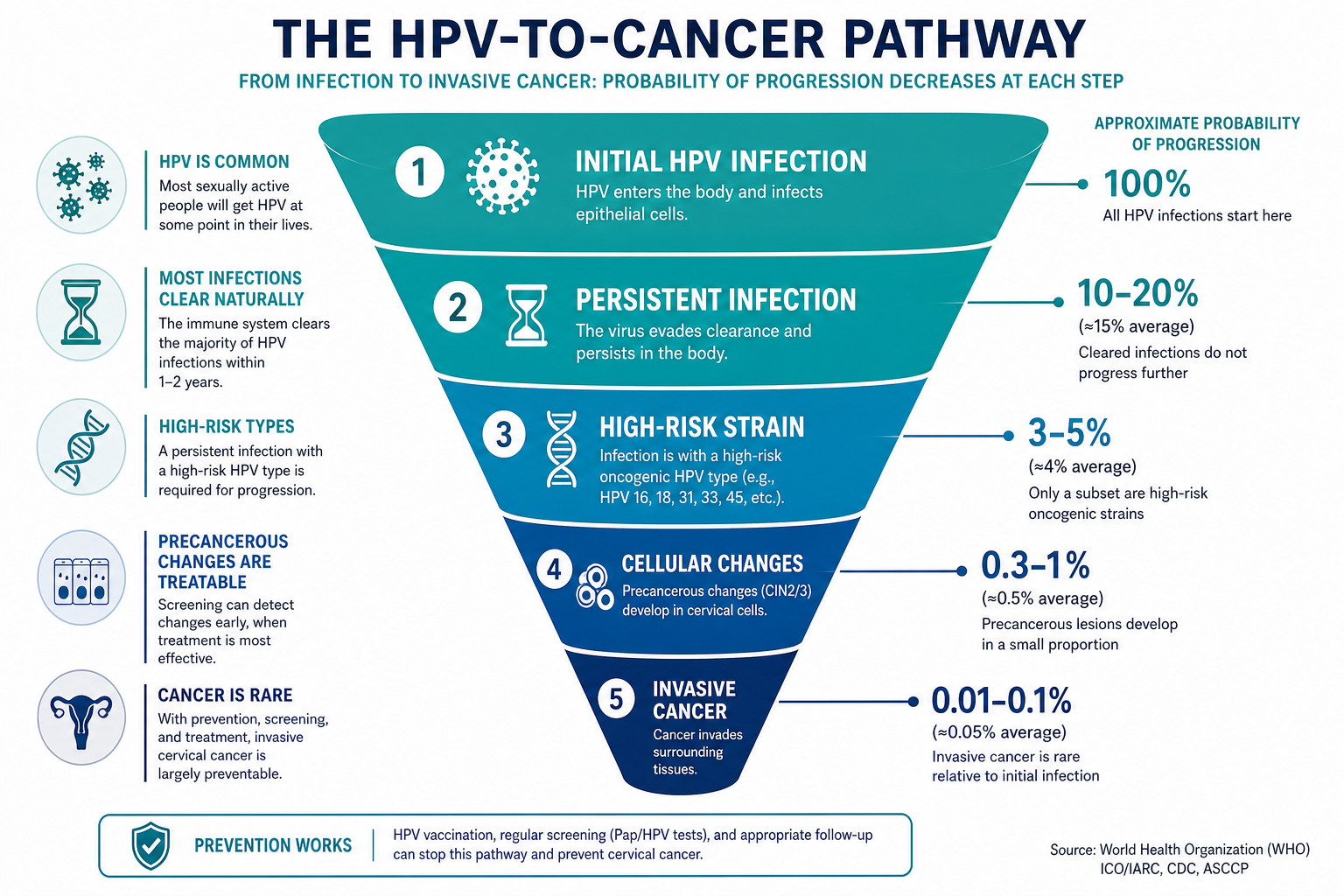
| Stage | What Has to Happen | Approximate Outcome |
|---|---|---|
| Initial HPV exposure | Virus contacts mucosal tissue | Very common — most sexually active adults |
| Infection establishes | Immune system does not clear immediately | Common — occurs in most exposures |
| Infection persists beyond 2 years | Immune system fails to suppress to undetectable | Approximately 10% of infections |
| High-risk strain present | Must be one of ~14 oncogenic types | A subset of persistent infections |
| Cellular changes develop | Viral proteins disrupt normal cell regulation | A minority of persistent high-risk infections |
| Invasive cancer | Cellular changes progress undetected for 10–20 years | Rare — especially with regular screening |
The cellular disruption at the precancerous stage involves specific viral proteins (E6 and E7 oncoproteins) that interfere with tumor suppression — for a full explanation of that biological mechanism, see this detailed breakdown of how HPV causes cancer. The key point for this article is simpler: each step in the table above is a gate that most infections do not pass through.
Understanding why HPV fails to clear in some people is central to understanding who faces elevated risk — and what can be done about it.
Which HPV Types Are Actually Linked to Cancer?
Not all HPV carries cancer risk. There are over 200 known HPV types, and the vast majority do not cause cancer. The types most people encounter — including those that cause common skin warts — have no meaningful cancer association. Even genital warts, caused by low-risk types 6 and 11, are not linked to cancer development.
Cancer risk is confined to approximately 14 high-risk mucosal HPV types. Among those, two stand out dramatically:
- HPV 16 accounts for approximately 50% of cervical cancers globally and is also the primary driver of oropharyngeal cancers in men — a cancer type that has been rising steadily.
- HPV 16 and 18 together account for approximately 70% of all cervical cancers worldwide, according to the World Health Organization.
- Other high-risk types — including 31, 33, 45, 52, and 58 — carry elevated risk but contribute a smaller share of cancer cases.
The National Cancer Institute notes that HPV is linked to approximately 5% of all cancers worldwide. That figure is worth holding in both directions: it confirms that HPV is a meaningful cancer risk factor, but it also confirms that the vast majority of HPV-positive people do not develop cancer.
If your positive result specifies HPV 16 or 18, that warrants more frequent monitoring — not panic, but heightened attention. For a thorough breakdown of what those specific strain results mean for your health, see this detailed guide on HPV 16 and HPV 18 and what these strains mean.
How Long Does It Take for HPV to Cause Cancer?
Cancer from HPV does not happen quickly. The pathway from an initial persistent infection to invasive cervical cancer typically takes 10 to 20 years. This is one of the most clinically important facts about HPV-related cancer — and it is almost universally underappreciated by people who have just received a diagnosis.
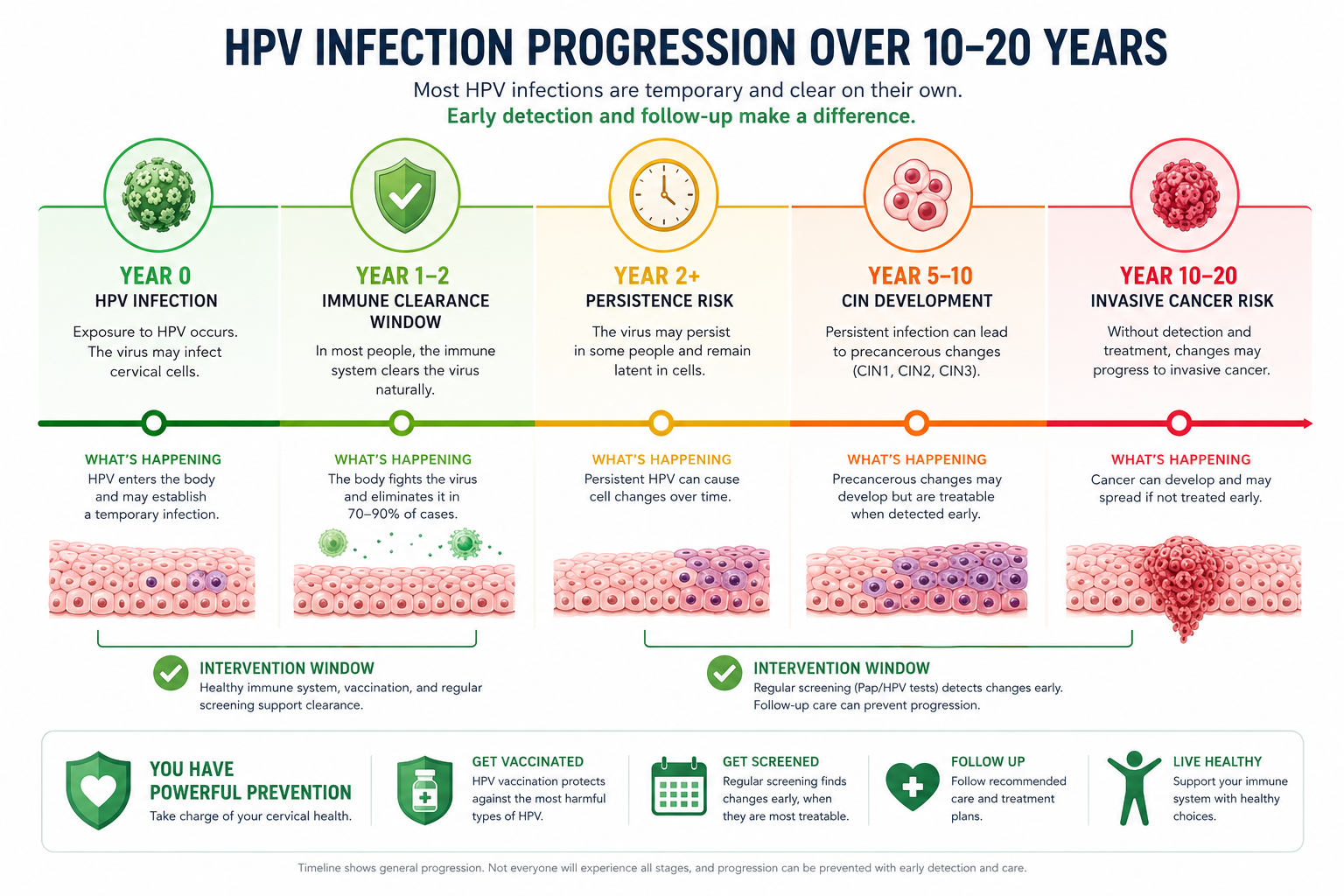
That extended timeline has two critically important implications.
First, it means the window for detection and intervention is extraordinarily wide. Cervical screening — Pap smears and HPV co-testing — is specifically designed to detect precancerous cellular changes (called CIN, or cervical intraepithelial neoplasia) years, often a decade or more, before they could progress to invasive cancer. Treated at the precancerous stage, outcomes are excellent. This is why cervical cancer rates have declined dramatically in countries with established screening programs.
Second, it means the HPV infection you have today is not an imminent cancer threat. It is a risk factor that requires monitoring and attention — but one that moves slowly and is detectable at every stage. The 10 to 20 year window is not a countdown. It is an opportunity for intervention, and the medical system has well-established tools to take advantage of it.
Who Is Most Likely to Progress?
The question most people are really asking when they search whether HPV can turn into cancer is a personal one: am I in the group whose infection clears, or the group at risk of progression? While no test can answer that with certainty for any individual, population-level research identifies consistent patterns.
| Factor | Associated With Clearance | Associated With Progression |
|---|---|---|
| HPV strain | Low-risk or other high-risk types | HPV 16 or 18 specifically |
| Infection duration | Under 12 months | Over 24 months persistent |
| Smoking status | Non-smoker | Active smoker — strongest modifiable factor |
| Immune status | Immunocompetent | HIV-positive or immunosuppressed |
| Screening adherence | Regular monitoring | Gaps in monitoring |
| Vitamin D status | Sufficient | Deficient |
| Age | Younger — faster immune response | Over 50 — declining immune surveillance |
These are population-level associations, not individual predictions. Having several risk factors does not mean progression is certain, and having none does not guarantee clearance. What the data consistently shows is that smoking is the most impactful modifiable factor — smokers with high-risk HPV have significantly higher rates of persistence and progression than non-smokers.
For a full analysis of modifiable and non-modifiable risk factors — including the evidence behind each — see this comprehensive resource on HPV and cancer risk.
Why Screening Changes the Equation Entirely
The reason cervical cancer is considered one of the most preventable cancers in the world is not luck — it is the existence of a reliable, widely available screening system that can detect the disease at its earliest, most treatable stages.

Pap smears detect abnormal cervical cells (CIN 1, 2, and 3) that represent precancerous changes — not cancer itself. When those changes are identified, targeted interventions (such as LEEP or cone biopsy) remove the affected tissue with high success rates, interrupting the pathway before invasive cancer develops. The ASCCP's risk-based management guidelines provide clinicians with a structured framework for determining how frequently each patient should be monitored based on their specific HPV type, cytology results, and history.
What screening accomplishes in practical terms:
- Detects CIN 1, 2, and 3 — precancerous changes that are treatable and not yet cancer
- Allows targeted intervention at the precancerous stage, where outcomes are excellent
- Identifies high-risk strains through HPV co-testing so more frequent monitoring can be applied where needed
- Creates a longitudinal record of cervical health that allows trends to be caught early
The data on this is unambiguous: the people whose HPV progresses to cancer are overwhelmingly those who missed screening, not those who were monitored. Following your provider's recommended schedule is the single highest-impact decision available to you. Do not skip appointments because you feel well — HPV and precancerous changes produce no symptoms.
What You Can Do to Reduce Your Risk

Understanding that HPV can turn into cancer — but rarely does with proper attention — points directly toward three areas of action.
Medical monitoring. Follow your provider's recommended follow-up schedule without exception. If you have been told to return in 12 months, return in 12 months. If your strain is HPV 16 or 18, ask specifically about more frequent co-testing. Screening is the intervention that has the greatest proven impact on preventing HPV-related cancer.
Lifestyle factors. Smoking cessation is the most evidence-supported modifiable action a person with high-risk HPV can take. Beyond that, adequate sleep, vitamin D optimization, stress reduction, and a diet rich in antioxidants all support immune function in ways that are relevant to viral clearance. For a practical guide to lifestyle strategies, see this resource on how to clear HPV naturally.
Immune support supplements. AHCC (Active Hexose Correlated Compound) is the only supplement with a published, placebo-controlled human clinical trial specifically examining HPV clearance. Research led by Dr. Judith Smith at the UT Health Science Center at Houston suggests that AHCC may support immune clearance of HPV — and clearing the infection removes the biological precondition for HPV-related cancer. This is the accurate framing: AHCC does not prevent cancer directly, and it is not FDA-approved as a cancer prevention strategy. It may support the immune process that resolves the infection. The evidence is promising and preliminary. NovaHerbs AHCC provides 700 mg per capsule, manufactured in the USA in a GMP-certified facility; the clinical protocol used in research is 3 grams per day on an empty stomach for a minimum of six months (approximately 4 to 5 capsules daily). For a full review of the clinical evidence, see does AHCC really help clear HPV. Additional AHCC research is available through PubMed.
Frequently Asked Questions
What percentage of HPV infections actually cause cancer?
The vast majority of HPV infections — approximately 90% — clear within two years and never cause cancer or any lasting harm. Of the roughly 10% that persist, only a fraction involve high-risk strains, and only a fraction of those will progress to precancerous changes, let alone invasive cancer. HPV is linked to approximately 5% of all cancers worldwide, which means that while the virus is a significant cancer risk factor, most people who carry it at some point in their lives will not develop HPV-related cancer.
Does HPV always cause cervical cancer?
No. HPV does not always cause cervical cancer, and the relationship between the two requires careful framing. While virtually all cervical cancers (approximately 99%) are linked to persistent high-risk HPV, this does not mean that most people with HPV develop cervical cancer. It means that when cervical cancer does occur, it is almost always HPV-related. The direction of causation matters: HPV is a necessary but not sufficient cause of cervical cancer, and most HPV infections resolve without ever reaching that outcome.
If I have HPV 16, will I definitely get cancer?
No. HPV 16 is the highest-risk strain and is responsible for approximately 50% of cervical cancers globally, as well as a significant share of oropharyngeal and other HPV-related cancers. However, many people carry HPV 16 and clear it without developing cancer. What HPV 16 does warrant is more careful monitoring, more frequent co-testing, and prompt follow-up on any abnormal results. It is a reason for heightened vigilance — not a cancer sentence.
How do I know if my HPV is becoming cancer?
HPV infection and even precancerous cervical changes (CIN) produce no symptoms — which is precisely why screening exists. There is no way to know from how you feel whether your infection is persisting or whether cellular changes are developing. The only reliable method is regular Pap smears and HPV co-testing on the schedule your provider recommends. If you have been diagnosed with HPV and have not yet established a monitoring plan with a healthcare provider, that is the most urgent next step.
Does clearing HPV eliminate my cancer risk?
Clearing HPV removes the active biological driver of HPV-related cellular changes and significantly reduces ongoing risk. However, it does not completely eliminate the possibility that changes from a prior infection could still be present in tissue. This is why continued screening is recommended even after a negative HPV test result. Your provider will advise on the appropriate follow-up interval based on your full history.
Conclusion
For anyone who has just received an HPV diagnosis and is asking whether HPV can turn into cancer, the honest, evidence-based answer is: it can, but for most people it does not — and the factors that determine which group you fall into are largely knowable and, in many cases, actionable.
The pathway from HPV infection to invasive cancer requires a specific sequence of events that takes 10 to 20 years and is detectable at every stage. The immune system clears approximately 90% of infections on its own. Screening catches the changes that the immune system misses. And lifestyle factors — particularly smoking cessation — meaningfully shift the odds.
Your next steps:
- Schedule or confirm your follow-up appointment. If you have not already established a monitoring plan with your provider, do so now. Ask specifically what your HPV type means for your screening interval.
- Quit smoking if you smoke. This is the single most impactful modifiable action for reducing HPV progression risk.
- Optimize your immune health. Prioritize sleep, vitamin D, and a diet that supports immune function. Review the evidence on lifestyle strategies for HPV.
- Ask about AHCC. If you are interested in immune support supplementation, discuss AHCC with your healthcare provider and review the available clinical research before starting.
- Stay consistent with screening. Do not let a period of feeling well become a reason to delay follow-up. The 10 to 20 year timeline of HPV-related cancer development means that gaps in monitoring are where risk accumulates.
Related Reading
- How HPV causes cancer: the biological mechanism explained
- HPV and cancer risk: what determines whether your infection progresses
- Does AHCC really help clear HPV? What the research actually shows
- Why HPV does not clear in some people — and what to do about it
References
- Centers for Disease Control and Prevention. HPV Fact Sheet. https://www.cdc.gov/hpv
- World Health Organization. Human papillomavirus (HPV) and cervical cancer. https://www.who.int/news-room/fact-sheets/detail/human-papillomavirus-(hpv)-and-cervical-cancer
- National Cancer Institute. HPV and Cancer. https://www.cancer.gov/about-cancer/causes-prevention/risk/infectious-agents/hpv-and-cancer
- PubMed — AHCC clinical research database. https://pubmed.ncbi.nlm.nih.gov/
- ASCCP. 2019 Risk-Based Management Consensus Guidelines. https://www.asccp.org/management-guidelines
These statements have not been evaluated by the Food and Drug Administration. This product is not intended to diagnose, treat, cure, or prevent any disease. Consult your healthcare provider before beginning any new supplement regimen.


