


A positive HPV test result does not always mean what people assume it means — and for many people sitting with that result right now, that distinction matters enormously. The question of whether you can get HPV without having sex is not just a biology question. For many people, it is a relationship question, a trust question, and sometimes a deeply painful one. The answer deserves to be stated clearly and without hedging: yes, HPV can spread without penetrative sex, and no, a positive test result cannot tell you when the infection occurred or who transmitted it. Both of those facts matter.
Key Takeaways
- HPV does not require penetrative sex to spread — skin-to-skin genital contact is sufficient for transmission.
- A positive HPV result can reflect an infection acquired months or years earlier, even in a long-term monogamous relationship.
- Research published in the Archives of Pediatric and Adolescent Medicine found HPV in 11.6% of young women who had never had intercourse.
- Condoms reduce HPV transmission risk by approximately 70% but do not eliminate it, because the virus spreads through skin contact, not only bodily fluids.
- Supporting your immune system is the most important step after diagnosis — the immune system is the primary mechanism through which HPV clears.
In This Article
- The short answer
- How HPV actually spreads
- Getting HPV without penetrative sex
- HPV dormancy — why timing is impossible to know
- HPV, relationships, and the infidelity question
- Can you get HPV as a virgin?
- Can HPV spread through surfaces or objects?
- Do condoms prevent HPV?
- What to do after an HPV diagnosis
- Frequently asked questions
The Short Answer
Yes. HPV does not require penetrative sex to spread. The CDC notes that HPV is transmitted through intimate skin-to-skin contact — specifically contact with infected genital skin or mucous membranes. Penetrative sex is the most common route of transmission simply because it involves the most sustained and direct contact between those tissues, but penetration itself is not a requirement. Any skin-to-skin contact involving infected genital areas can, in principle, transmit the virus.
This is not a technicality. It is a fundamental property of how HPV behaves, and it has real consequences for how people interpret a positive test result.
How HPV Actually Spreads
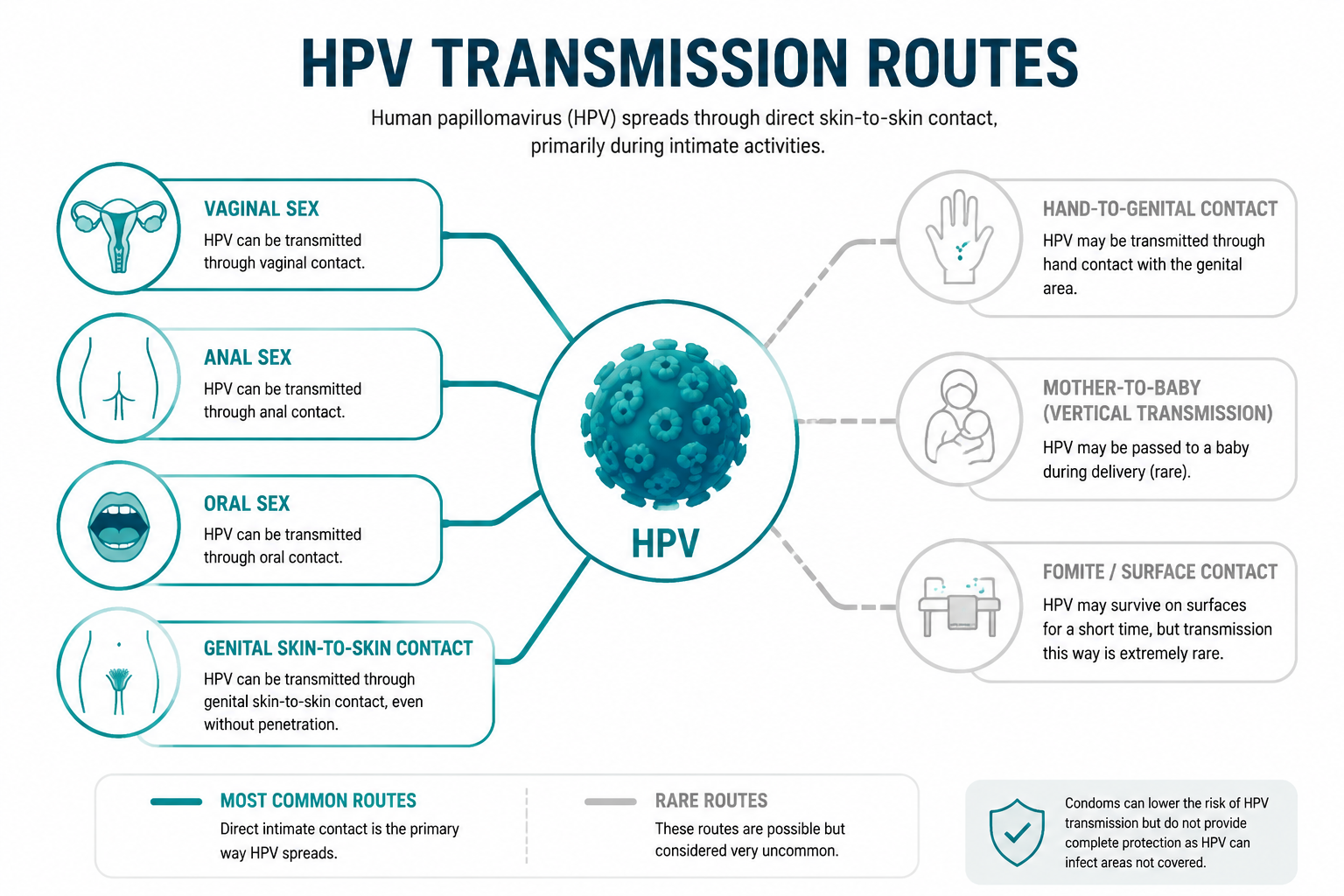
HPV lives in skin cells and the mucous membranes that line the genitals, anus, mouth, and throat. Unlike HIV or hepatitis B, it does not travel through blood or saliva in meaningful concentrations. Transmission occurs when infected skin or mucosa makes direct contact with another person's skin or mucosa — which is why condoms, while helpful, do not fully prevent transmission.
The table below summarizes the known transmission routes, their relative frequency, and relevant context.
| Transmission Route | How Common | Notes |
|---|---|---|
| Vaginal sex | Most common | Primary route for genital HPV strains |
| Anal sex | Common | Significant route, particularly relevant for men who have sex with men |
| Oral sex | Common | Can result in oral or throat HPV infection |
| Genital skin-to-skin contact | Less common | Does not require penetration |
| Hand-to-genital contact | Uncommon | Possible but less well-documented |
| Vertical (mother to baby) | Rare | Can cause recurrent respiratory papillomatosis in infants |
| Fomite (surfaces or shared objects) | Very rare | Evidence is limited and not well-established for genital strains |
Oral sex deserves specific mention here. HPV acquired through oral contact can establish infection in the throat and mouth — a topic covered in depth in the article on oral HPV: the silent infection no one talks about. For this article, the focus remains on genital transmission routes and what they mean for people who are questioning how they acquired the virus.
The NCI provides additional detail on how HPV transmission relates to cancer risk across different anatomical sites, which is worth reviewing separately.
Getting HPV Without Penetrative Sex
Genital skin-to-skin contact without any penetration is a documented route of HPV transmission. This is not theoretical — it has been confirmed in clinical research.
A study by Widdice et al., published in the Archives of Pediatric and Adolescent Medicine in 2011, examined HPV rates among young women who had never had sexual intercourse. The findings were striking: 11.6% of these sexually inexperienced young women tested positive for at least one HPV strain, including two cases of HPV-16, a high-risk strain. The researchers concluded that these infections most likely occurred through hand-to-genital or genital skin-to-skin contact.
This is not common. The majority of HPV infections are transmitted through vaginal, anal, or oral sex. But the Widdice data confirms that the virus does not require intercourse to spread — and that matters for anyone trying to understand how they could have acquired HPV without what they consider "full" sexual activity.
Planned Parenthood addresses this question directly, noting that any genital skin contact — including manual stimulation — carries a low but real transmission risk.
HPV Dormancy — Why Timing Is Impossible to Know
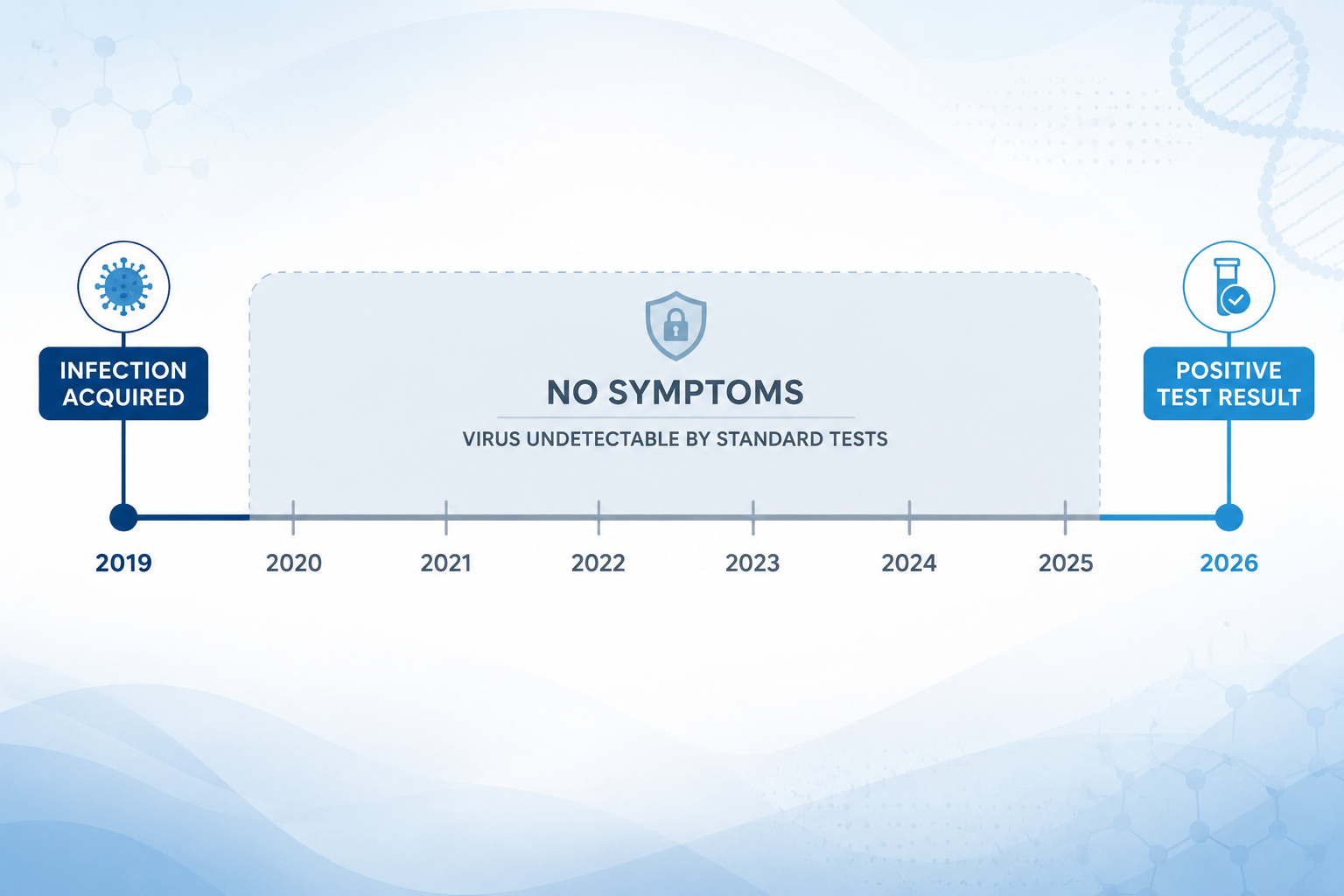
This section is the most important one for anyone in a relationship who has just received a positive HPV result. HPV can remain completely dormant — causing no symptoms and detectable by no standard test — for months or years after the initial infection. When it is eventually detected through a routine Pap smear or HPV co-test, there is no laboratory method to determine:
- When the infection was originally acquired
- Who transmitted it
- Whether it was recent or years old
This is not a gap in current testing technology that will eventually be filled. It is a fundamental property of how HPV behaves in the human body. The virus integrates into the host cell's DNA and can remain suppressed by the immune system for an extended period before becoming detectable. A positive result in 2026 could reflect an infection acquired in 2019, 2021, or at any point in between.
Men, in particular, have no approved routine HPV screening test, which means a male partner can carry and transmit HPV for years without any knowledge of the infection. The article on HPV in men — no symptoms, no test, still at risk explains this in detail and is worth reading for anyone trying to understand the full picture.
HPV, Relationships, and the Infidelity Question
An HPV diagnosis in a monogamous relationship does not prove infidelity. That statement is not a diplomatic softening of the facts — it is the medically accurate position, and it is important enough to state without qualification.
Here is why. Given HPV's dormancy period, either partner could have been carrying the virus for years before the relationship began, or from early in the relationship, without either person knowing. Given that the CDC estimates HPV is the most common sexually transmitted infection in the United States — with most sexually active people acquiring it at some point in their lives — prior exposure before a current relationship is entirely plausible and statistically common.
The medical literature does not support using an HPV diagnosis as evidence of infidelity. Physicians, gynecologists, and sexual health specialists consistently communicate this to their patients, because the alternative — treating a diagnosis as proof of betrayal — causes significant harm to relationships and individuals based on a misunderstanding of how the virus works.
That said, the emotional response to an HPV diagnosis is understandable. Learning that a partner has HPV, or receiving a diagnosis oneself, can trigger fear, confusion, and suspicion. Those feelings are real. The medical facts simply do not support the conclusion that a positive result means someone was unfaithful.
If this question is creating serious tension in a relationship, speaking with a healthcare provider together — so both partners can hear the medical explanation directly — is often more helpful than any article can be. The piece on dating with HPV: when to disclose and what to say also addresses the communication side of this challenge.

Can You Get HPV as a Virgin?
Yes — though it is uncommon. The Widdice study discussed earlier documented HPV-positive results in young women who had never had intercourse, with the most likely routes being genital skin contact without penetration or hand-to-genital contact. This is not a common scenario, but it is a documented one.
This finding has direct implications for vaccination guidance. HPV vaccination is recommended regardless of sexual experience precisely because exposure can occur without intercourse. Waiting until sexual activity begins to vaccinate may mean waiting until after exposure has already occurred.
For anyone who has received an HPV diagnosis and has never had penetrative sex, the Widdice data provides a medically grounded explanation. It is not impossible. It is not a sign that something is wrong with the immune system. It simply reflects the fact that HPV requires only skin contact — not intercourse — to transmit.
Can HPV Spread Through Surfaces or Objects?
HPV is more durable than many viruses. It can survive on surfaces for several days and is not easily destroyed by heat or standard alcohol-based disinfectants. Some studies have detected HPV DNA on medical instruments, surfaces in clinical settings, and shared personal items such as towels.
However, it is important to distinguish between detecting viral DNA on a surface and documented transmission through that surface. Fomite transmission of genital HPV strains is extremely rare and is not well-established in the clinical literature. Some evidence suggests it is theoretically possible, but it has not been confirmed as a meaningful route of transmission for genital HPV in the way that skin-to-skin sexual contact has been.
Cutaneous HPV strains — the ones that cause common skin warts — have been associated with transmission through shared surfaces and, in case reports, tattoo needles. Genital HPV strains behave differently and have a much weaker evidence base for surface transmission.
The practical takeaway: sharing towels or using public facilities is not a significant HPV risk for most people. The primary concern remains direct skin-to-skin contact.
Do Condoms Prevent HPV?
Condoms meaningfully reduce HPV transmission risk, but they do not eliminate it. Because HPV spreads through skin contact rather than through bodily fluids alone, any area of genital skin not covered by a condom remains a potential transmission site. The base of the penis, the scrotum, the vulva, and the perineum are all areas that a standard condom does not cover.
Studies suggest that consistent and correct condom use reduces HPV transmission risk by approximately 70%. That is a clinically meaningful reduction — but it is not complete protection. This is one of the core reasons that HPV vaccination is considered the most effective prevention strategy: it protects against specific high-risk and low-risk strains regardless of condom use.
For people who are sexually active and not yet vaccinated, consistent condom use combined with vaccination provides the strongest available protection against new HPV infections.
What to Do After an HPV Diagnosis
Receiving a positive HPV result is unsettling, but it is also extremely common. Most HPV infections clear on their own within one to two years, driven entirely by the immune system. Here are the most important steps to take.
1. Follow your provider's monitoring schedule. Depending on your HPV type and any associated cell changes, your provider will recommend a follow-up timeline — typically a repeat co-test in 12 months or a colposcopy if abnormal cells are present. Do not skip these appointments.
2. Support your immune system actively. The immune system is the only mechanism through which HPV clears. Smoking cessation, adequate sleep, stress reduction, and optimizing vitamin D levels all have documented effects on immune function. Research from the NIH supports the role of vitamin D in maintaining immune competence. Understanding why HPV does not clear in some people can help identify specific factors that may be slowing clearance.
3. Consider AHCC as an immune support supplement. AHCC (Active Hexose Correlated Compound) is currently the only supplement with a published, placebo-controlled human clinical trial specifically targeting HPV clearance. The trial was conducted by Dr. Judith Smith at the University of Texas Health Science Center at Houston, and results were published in peer-reviewed literature available through PubMed. The research protocol used 3 grams per day taken on an empty stomach for a minimum of six months. This research is promising and preliminary — it should be understood as immune support, not as a treatment for HPV. NovaHerbs AHCC provides 700 mg per capsule, manufactured in the USA in a GMP-certified facility, which means approximately four to five capsules per day at the research-validated dose. For a detailed review of the evidence, see does AHCC really help clear HPV, and for dosing specifics, the article on what dosage of AHCC to take for HPV covers the clinical data in full.
4. If you are in a relationship, focus on the facts. The sections above on dormancy and infidelity provide the medical framework. If the diagnosis is creating conflict, consider asking your provider to speak with both of you together. A calm, factual conversation with a clinician present can reduce the emotional charge significantly.
For a broader overview of natural immune support strategies, the guide on how to clear HPV naturally covers diet, lifestyle, and supplement approaches in detail.
Frequently Asked Questions
Can HPV be transmitted through kissing?
Standard kissing — mouth-to-mouth contact — is not considered a significant route for transmitting genital HPV strains. However, oral HPV can be acquired through oral sex, and some strains associated with throat cancer have been detected in saliva. The evidence for transmission through casual kissing alone is not well-established. If you have concerns about oral HPV specifically, the dedicated article on oral HPV covers this topic in full clinical detail.
Can you get HPV from a toilet seat or towel?
HPV DNA has been detected on surfaces including towels and medical equipment in some studies. However, documented transmission of genital HPV strains through shared objects or surfaces is extremely rare and not well-established in clinical literature. Some evidence suggests it is theoretically possible, but it is not considered a meaningful route of transmission for most people. The risk from casual surface contact is very low compared to direct skin-to-skin genital contact.
Does HPV mean my partner cheated?
No — and this cannot be stated strongly enough from a medical standpoint. HPV can remain dormant for months or years before being detected, meaning a positive result in 2026 could reflect an infection acquired years before the current relationship began. Either partner could have been carrying the virus without knowing. The medical literature does not support using an HPV diagnosis as evidence of infidelity. If this question is causing relationship distress, speaking with a healthcare provider together is the most constructive next step.
Can a virgin have HPV?
Yes, though it is uncommon. Research by Widdice et al. (2011) found that 11.6% of young women who had never had intercourse tested positive for HPV, most likely through hand-to-genital or genital skin-to-skin contact without penetration. HPV vaccination is recommended regardless of sexual experience for this reason — exposure can occur before intercourse takes place.
How long can HPV stay dormant before being detected?
There is no fixed upper limit. HPV can remain dormant — suppressed by the immune system and undetectable by standard tests — for months or for many years. Most people who are infected never develop symptoms and never know they had the virus. When it is eventually detected, there is no way to determine when the infection originally occurred. This dormancy period is one of the most important and least understood aspects of HPV biology, and it is the primary reason that a positive test result cannot be used to establish a timeline of transmission.
Conclusion
Understanding how HPV actually spreads — and what a positive result does and does not mean — is not just a matter of biology. For many people, it is the difference between a diagnosis that damages a relationship and one that is managed calmly with accurate information.
Numbered next steps for anyone who has just received a positive HPV result:
- Schedule a follow-up with your healthcare provider and clarify the recommended monitoring interval based on your specific HPV type and any associated findings.
- Do not attempt to establish a timeline or assign blame based on the diagnosis. HPV dormancy makes this medically impossible, and the attempt causes harm without producing accurate information.
- Assess and strengthen your immune system — review sleep quality, vitamin D status, smoking habits, and stress levels, all of which have documented effects on the immune response to HPV.
- Research immune support options such as AHCC, which has a published human clinical trial supporting its use for HPV clearance. Discuss any supplement with your provider before starting.
- Stay informed and proactive rather than passive. Most HPV infections clear within one to two years with a healthy immune system. The evidence strongly supports active immune support over a "wait and see" approach.
Related Reading
- For a complete overview of natural immune strategies after diagnosis: how to clear HPV naturally — 10 proven strategies
- For the clinical evidence behind AHCC and HPV: does AHCC really help clear HPV
- For understanding why some infections persist longer than others: why HPV does not clear in some people
- For the communication side of an HPV diagnosis in a relationship: dating with HPV: when to disclose and what to say
References
- Centers for Disease Control and Prevention. HPV Fact Sheet. https://www.cdc.gov/hpv
- Widdice LE, Moscicki AB, Weiss G, et al. Rates of HPV Infection Among Young Women Not Yet Sexually Active. Archives of Pediatric and Adolescent Medicine. 2011.
- Planned Parenthood. How did I get HPV if I haven't had sex? https://www.plannedparenthood.org/blog/how-did-i-get-human-papillomavirus-hpv-if-i-havent-had-sex-7
- National Cancer Institute. HPV and Cancer. https://www.cancer.gov/about-cancer/causes-prevention/risk/infectious-agents/hpv-and-cancer
- National Institutes of Health, Office of Dietary Supplements. Vitamin D — Health Professional Fact Sheet. https://ods.od.nih.gov/factsheets/VitaminD-HealthProfessional/
- PubMed — AHCC clinical research database. https://pubmed.ncbi.nlm.nih.gov/
- Smith JA, et al. Active Hexose Correlated Compound (AHCC) and HPV clearance — published clinical trial data. University of Texas Health Science Center at Houston.
These statements have not been evaluated by the Food and Drug Administration. This product is not intended to diagnose, treat, cure, or prevent any disease. Consult your healthcare provider before beginning any new supplement regimen.
By Dr. Zafer Atli | Integrative Medicine & Women's Health


