


Every credible AHCC resource says the same thing: take it on an empty stomach. But very few explain where that instruction comes from or what actually happens if you skip it. The answer matters — because this recommendation is not generic supplement marketing. It comes directly from the clinical trial protocol used in the only published, placebo-controlled human study examining AHCC for HPV clearance. Understanding that distinction changes how seriously you take the instruction.
Key Takeaways
- The empty-stomach recommendation originates from Dr. Judith Smith's Phase II clinical trial at the University of Texas Health Science Center at Houston — not from general supplement guidelines.
- AHCC-specific pharmacokinetic data comparing fasted versus fed absorption does not yet exist; the recommendation is supported by the trial protocol and general principles of polysaccharide absorption.
- Food — particularly fat and protein — slows gastric emptying, which may reduce the efficiency of polysaccharide uptake.
- Morning dosing, immediately upon waking with plain water, is the most practical way to replicate the trial protocol consistently.
- Consistency of timing over the full protocol period matters more than occasional perfect execution.
In This Article
- Where the empty-stomach recommendation comes from
- Why fasted dosing may improve absorption
- What happens if you take AHCC with food
- Best time of day to take AHCC
- How long to wait before eating
- What to take AHCC with
- Combining AHCC with other supplements
- Common timing mistakes
- Frequently asked questions
The empty-stomach protocol is not arbitrary — it comes directly from the clinical trial design used in the published HPV research.
Where the Empty-Stomach Recommendation Comes From
The instruction to take AHCC on an empty stomach traces back to one specific source: the Phase II clinical trial conducted by Dr. Judith Smith and her team at the University of Texas Health Science Center at Houston. That trial is the most rigorous published, placebo-controlled human study examining AHCC in the context of HPV clearance, and participants in that trial took AHCC on an empty stomach. The protocol was not designed to test absorption timing — it was designed to test whether AHCC supported immune response to persistent HPV infection. The fasted dosing was simply how the study was run.
This distinction is worth holding onto. When people ask whether AHCC works, the honest answer is: the evidence comes from a specific protocol. If you want to replicate the conditions under which results were observed, replicating that protocol as closely as possible is the most defensible approach. That includes the empty-stomach instruction.
What the trial did not include was a dedicated pharmacokinetic arm comparing AHCC absorption in fasted versus fed states. That study has not been done. So when the question is "why take AHCC on empty stomach," the first and most accurate answer is: because that is the protocol used in the published research on AHCC for HPV, and deviating from it introduces a variable that the evidence does not account for.
For those asking about the specific dose used in that trial, the AHCC dosage protocol for HPV is covered in detail separately. According to CDC data, HPV is the most common sexually transmitted infection in the United States, and the search for evidence-based immune support options is understandably urgent for those recently diagnosed.
Why Fasted Dosing May Improve Absorption
Since AHCC-specific absorption data comparing fasted and fed states does not exist, the case for taking AHCC on an empty stomach rests on general principles of how polysaccharides behave in the gastrointestinal tract.
AHCC's primary bioactive fraction is alpha-1,4-glucan — a low-molecular-weight polysaccharide derived from the mycelia of shiitake mushrooms. For more on how these compounds interact with immune function, see how AHCC works at a mechanistic level. Polysaccharides are absorbed primarily through the wall of the small intestine. To reach the small intestine, they must first pass through the stomach. The speed of that transit — known as gastric emptying — is significantly influenced by what else is in the stomach at the time.
Several well-established principles apply here:
- Fat and protein slow gastric emptying substantially. A meal containing fat and protein can delay gastric emptying by two to four hours compared to a fasted state. During that delay, the stomach contents — including any supplement taken with the meal — sit in an acidic environment longer.
- Increased stomach acid production accompanies food intake. A fasted stomach produces relatively less acid. Reduced acid exposure during transit may help preserve more of the bioactive compounds before they reach the small intestine.
- Fasting accelerates gastric emptying. Plain water and capsules taken on an empty stomach move through the stomach and into the small intestine relatively quickly, reducing the time spent in the acidic gastric environment.
Research on gastric emptying and nutrient absorption supports the general principle that fasted conditions allow faster transit from stomach to small intestine. These are not AHCC-specific findings — they are principles of gastrointestinal physiology that apply broadly to polysaccharide compounds.
The honest framing is this: fasted dosing is not proven to improve AHCC absorption in a controlled trial. It is supported by the trial protocol and by general absorption science. That is a meaningful distinction, and it is worth being clear about.
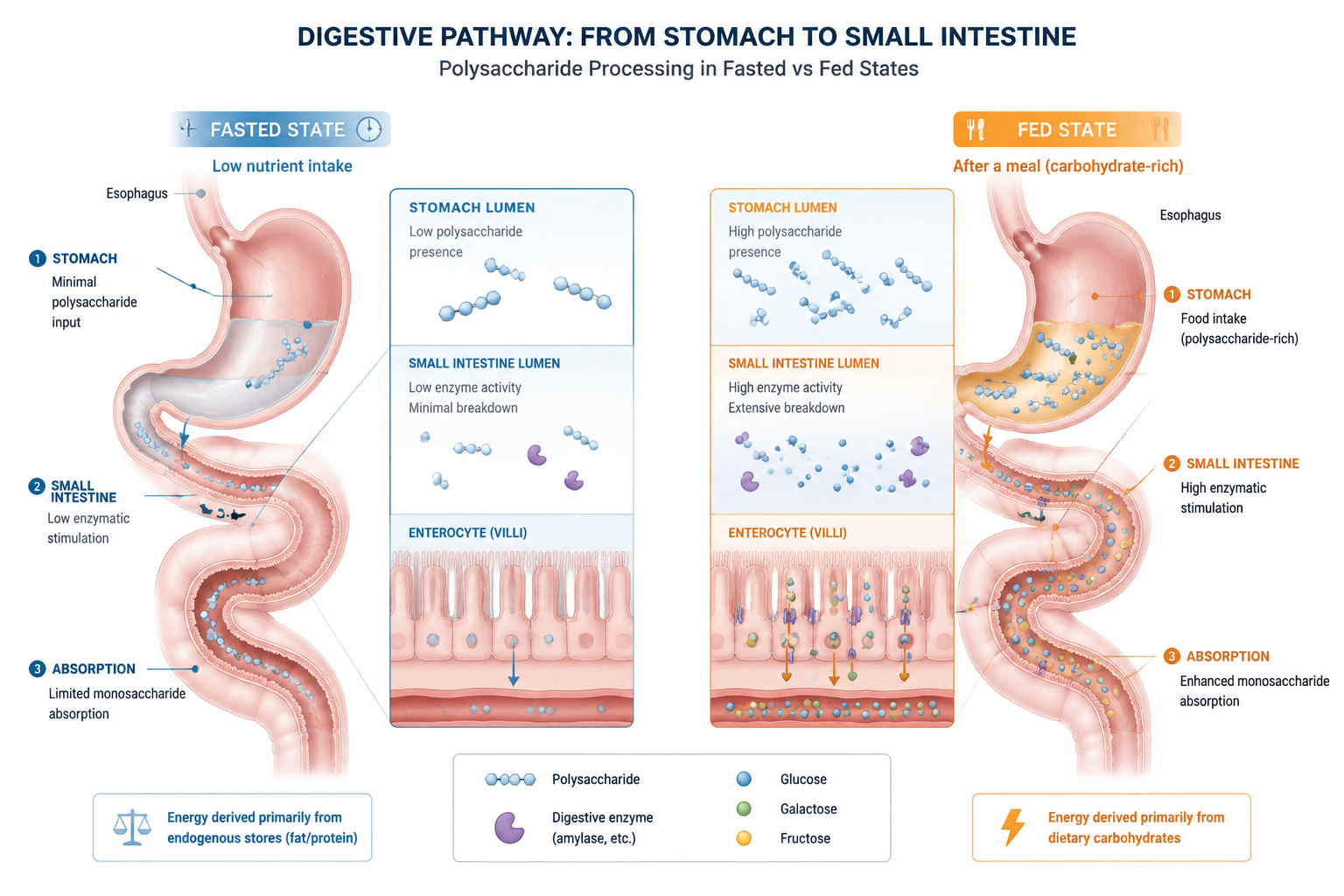
General principles of polysaccharide absorption suggest fasted conditions allow faster transit to the small intestine.
What Happens If You Take AHCC With Food
Taking AHCC with food does not render it completely ineffective. Some absorption will still occur. The concern is about efficiency and protocol fidelity, not total loss.
The specific variables introduced by taking AHCC with food include:
- Slowed gastric emptying. Fat- and protein-rich meals are the most significant factor. A full breakfast can delay gastric emptying considerably, meaning the AHCC capsules spend more time in the stomach's acidic environment before reaching the small intestine.
- Competitive absorption environment. The small intestine handles multiple compounds simultaneously during digestion. Whether this meaningfully reduces polysaccharide uptake in practice is not established for AHCC specifically, but the principle is relevant.
- Altered gut pH. Coffee, juice, and acidic foods change the pH environment of the upper GI tract. This introduces an additional variable that was not present in the trial protocol.
The practical takeaway: taking AHCC with food occasionally — because of travel, schedule disruption, or an unavoidable early meal — is not catastrophic. Taking it consistently with food, every day, over a six-month protocol, represents a meaningful departure from the conditions under which the research was conducted. Whether that departure reduces efficacy in practice is unknown. What is known is that the trial did not use fed dosing.
Best Time of Day to Take AHCC
Morning, immediately upon waking, before coffee, food, or other supplements, is the most practical time for most people to achieve a genuinely fasted state. After six to eight hours of overnight sleep, the stomach is empty and gastric emptying will be rapid. This is the closest replication of a true fasted state that most daily schedules allow.
Some people prefer to take AHCC before bed — also a fasted state if it has been three or more hours since the last meal. Either timing can work. The more important variable is not morning versus evening — it is consistency. A protocol that is taken at the same time every day, reliably, for six months, is more valuable than a perfect timing window that gets skipped three days a week because the schedule shifted.
Morning dosing has one practical advantage: it anchors to a fixed routine. Waking up, taking AHCC with a full glass of water, and then going about the morning is a simple habit that does not depend on remembering to stop eating three hours before bed. For most people, that makes morning the more sustainable choice.
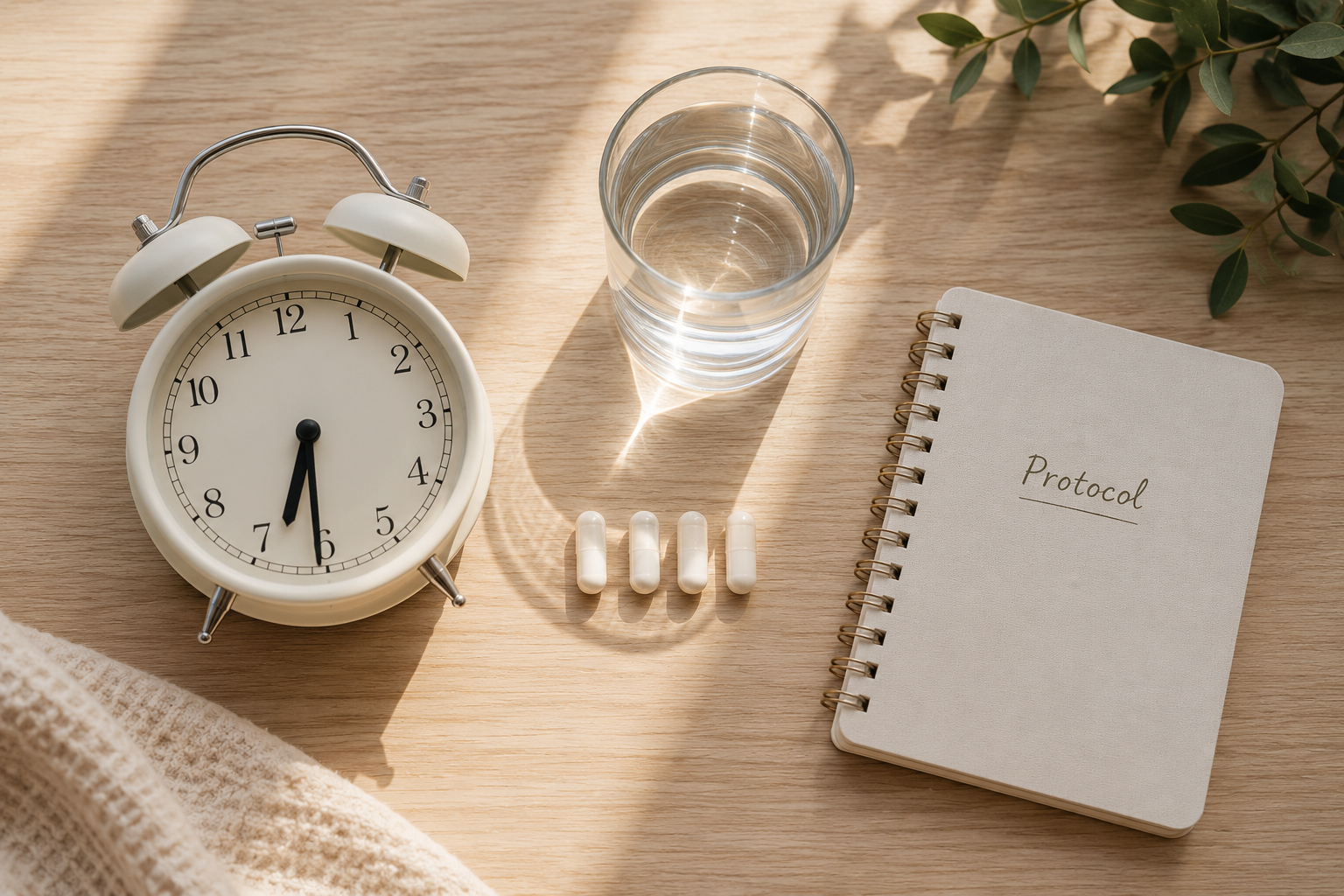
Morning dosing on an empty stomach — before coffee, food, or other supplements — is the protocol used in published research.
How Long to Wait Before Eating
The published trial protocol does not specify an exact waiting period after taking AHCC before eating. The commonly cited guidance of 30 to 60 minutes is derived from general polysaccharide absorption timelines rather than from AHCC-specific data.
A practical target: wait at least 30 minutes before eating, with 45 to 60 minutes being preferable where the schedule allows. Plain water during that window is fine. Coffee, juice, and food are not.
If the schedule requires eating sooner — say, within 20 minutes of waking — taking AHCC with water on a genuinely empty stomach and eating 20 to 25 minutes later is still meaningfully closer to the trial protocol than taking it with breakfast. A shorter wait on an empty stomach is preferable to no empty stomach at all.
What to Take AHCC With
Plain, still water is the correct choice. A full glass — approximately 250 to 300 ml — is ideal. The volume helps move the capsules efficiently from the stomach into the small intestine.
The reasons to avoid other liquids are practical:
- Coffee: Caffeine alters gut motility and gastric pH. Acidic coffee may also affect polysaccharide stability during transit. Coffee also begins the physiological shift away from a fasted state in some individuals.
- Juice: Fructose and citric acid change the gut environment during absorption. Orange juice and grapefruit juice in particular can interact with various compounds during GI transit.
- Milk or dairy beverages: Fat and protein content immediately begins the fed state, introducing the same gastric emptying delay as food.
- Sparkling water: Carbonic acid changes gut pH minimally, but plain still water is the simpler and more neutral choice.
The principle is straightforward: the goal is to maintain the fasted state during AHCC transit through the stomach and into the small intestine. Plain water supports that; everything else introduces variables.
Combining AHCC With Other Supplements
Many people taking AHCC for HPV support are also taking vitamin D, folate, zinc, or other immune-supportive nutrients. The simplest approach is sequential: take AHCC first, with plain water on an empty stomach, then take all other supplements with breakfast 30 to 60 minutes later.
This preserves the fasted state for AHCC while ensuring other supplements are taken with food where that is appropriate. A few specific combinations are worth noting:
- Probiotics: Take with food, not alongside AHCC. Probiotics benefit from a buffered gut environment that food provides; the acidic, fasted stomach is not an ideal environment for probiotic organisms.
- Fat-soluble vitamins (D, K, E, A): These require dietary fat for absorption. They should be taken with a meal containing fat, not in a fasted state alongside AHCC.
- Vitamin C and B vitamins: Water-soluble and less timing-dependent. Taking them with breakfast is straightforward and appropriate.
For those using NovaHerbs AHCC 700 mg capsules, the research protocol dose of 3 grams per day means approximately four to five capsules taken together once daily on an empty stomach. Manufactured in a GMP-certified facility in the USA, each capsule delivers 700 mg of AHCC — making dose calculation straightforward.
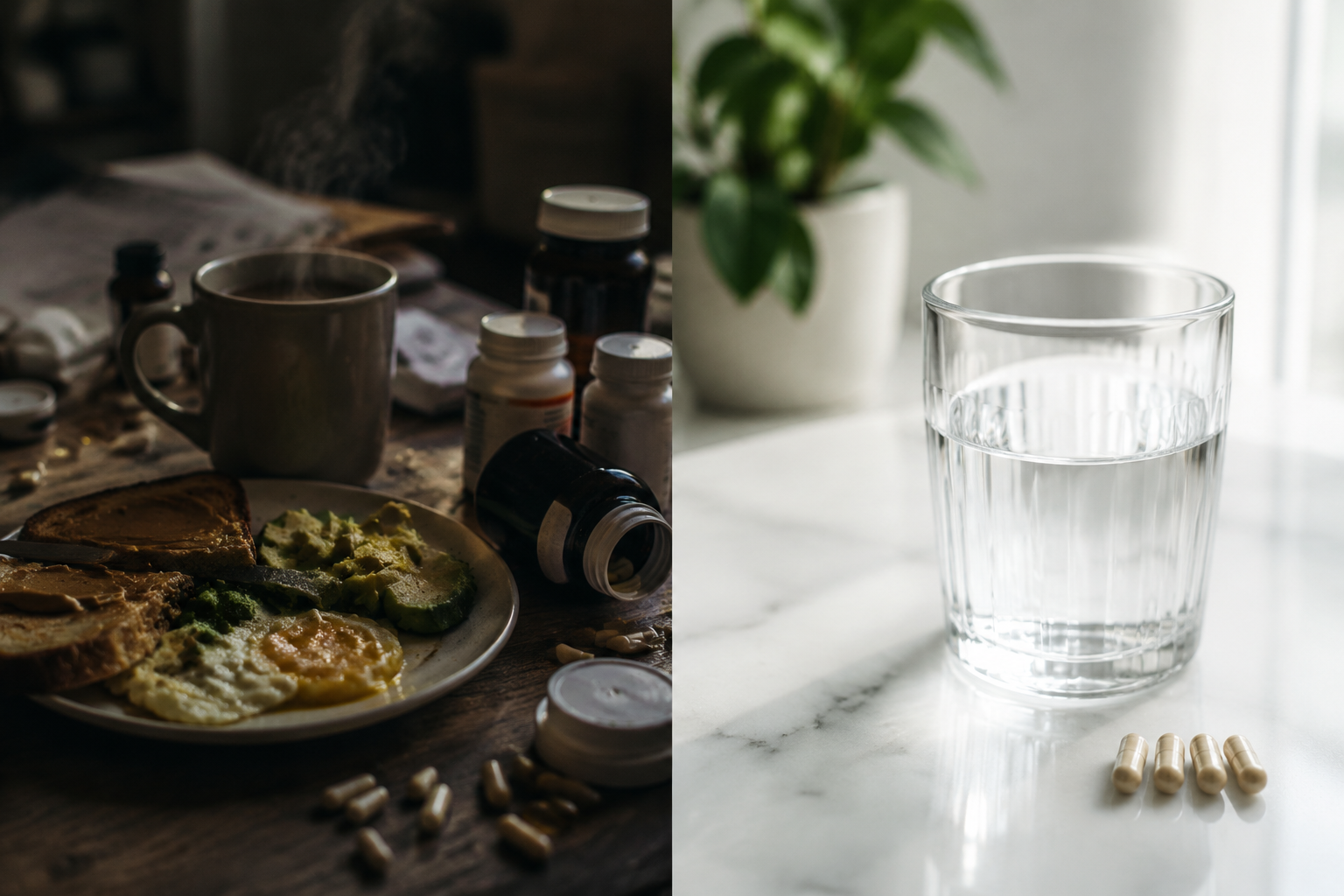
NovaHerbs AHCC provides 700 mg per capsule — at the research protocol dose of 3 grams, that is approximately 4 to 5 capsules taken together on an empty stomach.
Common Timing Mistakes
Timing errors are among the most common reasons people do not get the results they expected from an AHCC protocol. For a broader look at why AHCC protocols sometimes fall short, the real reasons AHCC did not work covers the full picture beyond timing alone.
The table below summarizes the most frequent mistakes and how to correct them:
| Mistake | Why It Matters | Better Approach |
|---|---|---|
| Taking with coffee | Alters gut pH and motility; begins departure from fasted state | Water only; coffee after 30–60 minutes |
| Taking with or right after food | Slows gastric emptying; introduces competitive absorption environment | True empty stomach — 3+ hours after last meal, or immediately on waking |
| Inconsistent daily timing | Disrupts protocol fidelity over a 6-month course | Same time every day; morning anchors consistency for most people |
| Splitting dose unevenly across the day | No evidence supports divided dosing for AHCC; trial used once-daily protocol | Once daily on an empty stomach, as per trial protocol |
| Taking with other supplements simultaneously | Uncertain interaction effects on absorption | AHCC alone first; all other supplements with food afterward |
| Skipping doses and doubling up the next day | Does not compensate for missed doses | Take the next scheduled dose at the normal time; do not double |
Coffee, food, and inconsistent timing are the three most common reasons people undermine an otherwise solid AHCC protocol.
Frequently Asked Questions
Can I take AHCC if I have to eat early in the morning?
Yes. The priority is taking AHCC on an empty stomach, not taking it at a specific clock time. If an early schedule requires eating by 6:30 AM, set the alarm 30 to 45 minutes earlier, take AHCC with water immediately upon waking, and eat after the waiting period. If that is not possible, taking AHCC before bed — at least three hours after the last meal — is a reasonable alternative that still preserves a fasted state.
Does it matter if I occasionally take AHCC with food?
Occasional deviation from the fasted protocol is not likely to undermine the entire course. The concern is consistent, repeated dosing with food over weeks and months — that represents a meaningful departure from the trial conditions. If a day arises where the choice is between taking AHCC with food or skipping the dose entirely, taking it with food is preferable to skipping. Consistency of dosing over the protocol period matters.
Can I take AHCC before bed instead of in the morning?
Yes, provided it has been at least three hours since the last meal. A fasted state achieved through an evening gap between dinner and bedtime is physiologically equivalent to a morning fasted state. Some people find bedtime dosing easier to maintain consistently because it does not require adjusting the morning routine. Either timing is appropriate; the key is that the stomach is genuinely empty.
What if I forget to take AHCC on an empty stomach — should I skip the dose?
Do not skip the dose. If the empty-stomach window has passed and food has been eaten, take AHCC at the next available fasted opportunity — either before the next meal (if three or more hours have passed since eating) or the following morning. Do not double the dose to compensate. A single missed fasted window is less consequential than skipping a dose entirely over a six-month protocol.
Can I take AHCC with black coffee if I add nothing to it?
This is a common question. Black coffee, even without additives, is acidic and alters gut motility through caffeine. It is not equivalent to plain water in terms of the gastric environment it creates. The trial protocol used water. If the choice is between black coffee and waiting 30 minutes for the coffee, waiting is the better option. If the schedule makes that impossible on a given day, black coffee is a lesser deviation than a full meal — but plain water remains the correct choice.
Conclusion
The question of why take AHCC on empty stomach has a straightforward answer: because that is the protocol used in the clinical trial that generated the published evidence, and because general principles of polysaccharide absorption support the rationale for fasted dosing. These two reasons together make the empty-stomach instruction worth following carefully.
Actionable next steps:
- Establish a fixed morning routine. Set a consistent time — immediately upon waking — to take AHCC with a full glass of plain water before anything else.
- Wait 30 to 60 minutes before eating or drinking coffee. Use that window for a shower, light stretching, or other morning tasks that do not involve food or acidic beverages.
- Sequence other supplements with breakfast. Fat-soluble vitamins, probiotics, and other daily supplements belong with food — not alongside AHCC in the fasted window.
- Maintain the protocol for the full recommended duration. Timing precision matters most when it is applied consistently over months, not just occasionally. For guidance on the full timeline, see how long to take AHCC for HPV clearance.
Related Reading
- What dosage of AHCC is recommended for HPV? — A detailed breakdown of the clinical trial dose and how to apply it practically.
- How does AHCC work to support immune response to HPV? — The mechanism behind AHCC's alpha-glucan fraction and its interaction with immune function.
- The real reasons AHCC did not work for some people — Timing is one factor; this article covers the full range of protocol errors that reduce effectiveness.
- Does AHCC really help clear HPV? What the research actually shows — A balanced review of the clinical evidence for those who want to understand the data behind the protocol.
References
- Smith JA, Julius A, Darcy KM. AHCC supplementation to support immune function to clear persistent HPV infections. Published clinical trial data available via PubMed — AHCC clinical research.
- Centers for Disease Control and Prevention. HPV fact sheet. CDC HPV information.
- National Institutes of Health — National Library of Medicine. Gastric emptying, nutrient absorption, and gastrointestinal physiology. NIH — Gastric emptying and nutrient absorption.
These statements have not been evaluated by the Food and Drug Administration. This product is not intended to diagnose, treat, cure, or prevent any disease. Consult your healthcare provider before beginning any new supplement regimen.
By Dr. Zafer Atli | Integrative Medicine & Women's Health


